Find your match.
Explore matches from the ATP, WTA, Challenger (CH), and ITF tours. Filter by player and tour to find the matchups you want to follow.
TENNIS INTELLIGENCE. HUMAN DECISIONS.
Understand the matchup. Put the probabilities in perspective. Make your own call.
MatchViewIQ brings tennis analysis, estimated win probabilities, and recorded results into one clear view.
Join the beta waitlist. No payment required.
There’s Hindsight.
Then there’s MATCHVIEW IQ.
LESS GUESSWORK. MORE CONTEXT.
You don’t need to know every player—or every trading term—to get started.
Explore matches from the ATP, WTA, Challenger (CH), and ITF tours. Filter by player and tour to find the matchups you want to follow.
A win probability is an estimate of a player’s chances. It gives you context for a matchup, with uncertainty still in the picture.
Use the information to follow tennis more closely or inform your own decisions on a separate trading platform.
A LOOK INSIDE MATCHVIEWIQ
Purposeful screens. Clear numbers.
Explore the actual app below.
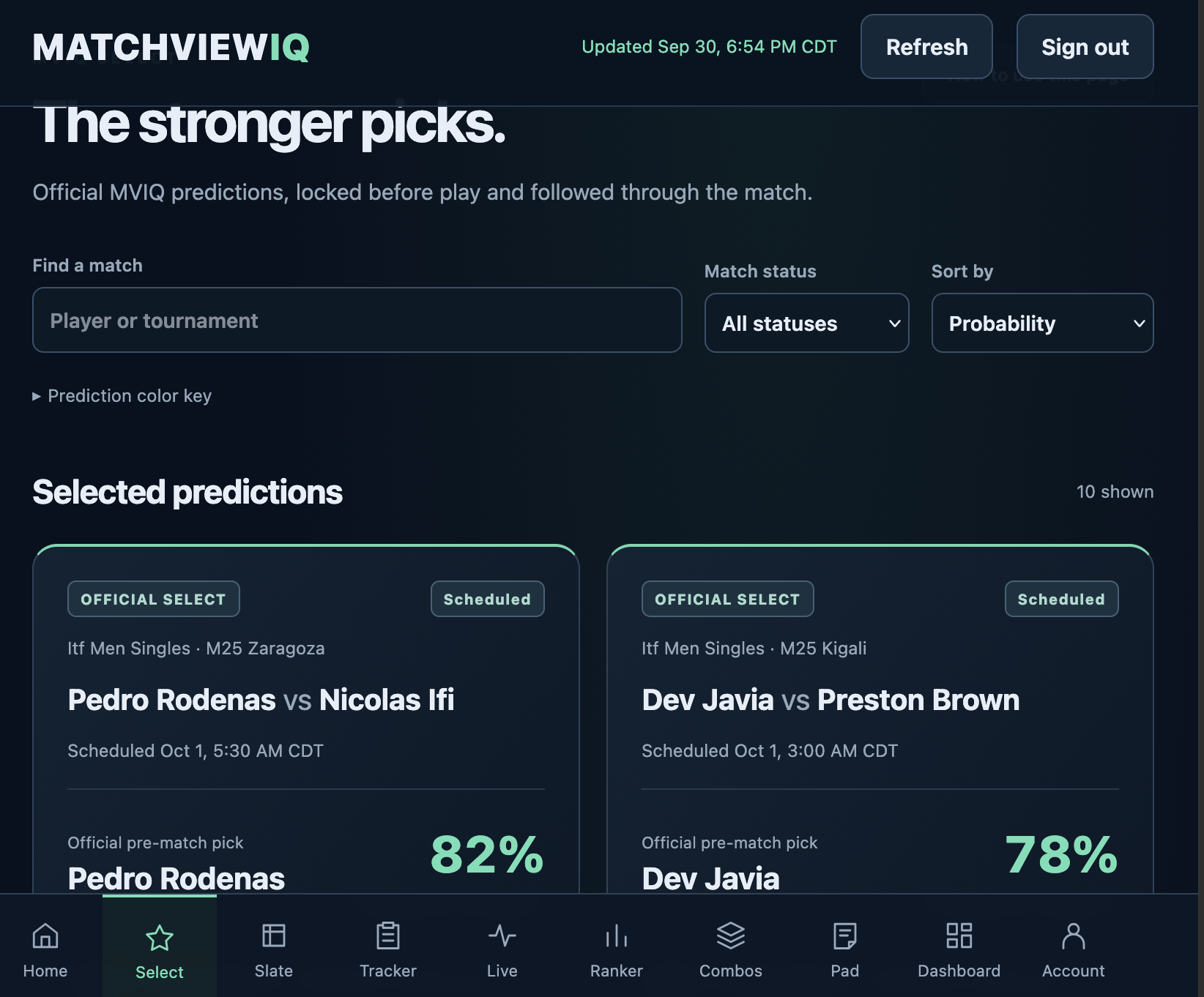
See MVIQ’s official pre-match selections, who the forecast favors, and the estimated chance of winning. Search for a player or tournament and sort the view.
“Which matches should I look at first?”
Actual beta screenshot from September 30, 2026. Match data shown is historical, not a current recommendation.
NEW TO ALL THIS? START HERE.
A few useful ideas, without the jargon.
An estimate of 70% means the analysis favors that player. If that estimate were well calibrated, players in similar situations would win about 70 out of 100 times—and lose about 30.
A favorite can still lose. Probability describes uncertainty; it doesn’t remove it.
Players win points to win games, games to win sets, and sets to win the match. Many singles matches are best of three sets: the first player to win two sets wins.
A break of serve means winning a game while the other player serves. Match formats vary, so check the tournament’s rules.
A marketplace where people trade contracts on outcomes, such as whether a player wins. For a standard $1 binary contract, a correct outcome pays $1 at settlement; an incorrect outcome pays $0.
A price of 60¢ roughly reflects a 60% market-implied chance. It is a market price, not a fact. Fees, available buyers and sellers, and the contract’s rules matter.
You can compare MVIQ’s estimate with a price on a separate platform. A 70% estimate and a 60¢ purchase price raise a research question: does the information justify the difference?
MVIQ estimates can be wrong and may already incorporate market information. A difference alone is not proof of value or a reason to trade. You make the decision and place any order separately.
The bid is a buyer’s offered price; the ask is a seller’s requested price. The gap between the best bid and ask is the spread.
You may be able to sell before a match ends, but you need a buyer. An order at your chosen price may not fill.
Imagine buying one “Yes” contract that pays $1 if your chosen player wins.
If you buy at 60¢ and find a buyer at 70¢, the result is +10¢ before fees.
Illustration only. Assumes a standard $1/$0 settlement. Fees are excluded. Special rules may apply to retirements, cancellations, or other outcomes. You can lose your purchase amount plus fees.
Continue learning at Kalshi’s Help Center ↗ or Polymarket’s Help Center ↗. Platform eligibility and rules vary. MVIQ is an independent analysis tool.
A LITTLE PERSPECTIVE GOES A LONG WAY.
Follow the sport with more context. Explore a matchup. Compare a forecast with a market price. Review the recorded results.
MVIQ helps you ask better questions. It doesn’t place trades, connect to your trading account, or guarantee an outcome.
Be part of the betaA FEW GOOD QUESTIONS
No. MatchViewIQ is a tennis analysis engine. Any trading happens independently on the platform you choose. MVIQ does not execute orders or provide a Kalshi or Polymarket trading integration.
No. You can use MVIQ to research matches, understand estimated probabilities, and follow the recorded results simply because you enjoy tennis.
No. They are estimates of the chance of winning, and even strong favorites lose. A forecast percentage is different from an overall accuracy rate, and neither is a promise of profit.
They show the beta app on September 30, 2026. The Tracker screenshot reports 66 wins and 19 losses across 85 graded matches (77.6%). This is a small historical sample shown by the app, not an independently audited result, a current figure, or a measure of trading returns.
Request early access below to join the beta waitlist. Pricing and a general release date have not been announced. Joining the list is free and does not require a payment or trading account.
MATCHVIEWIQ / EARLY ACCESS
Join the beta waitlist and be part of what comes next.
INSIDE MVIQ / COMBOS
Explore several picks together—and understand what changes when every result matters.
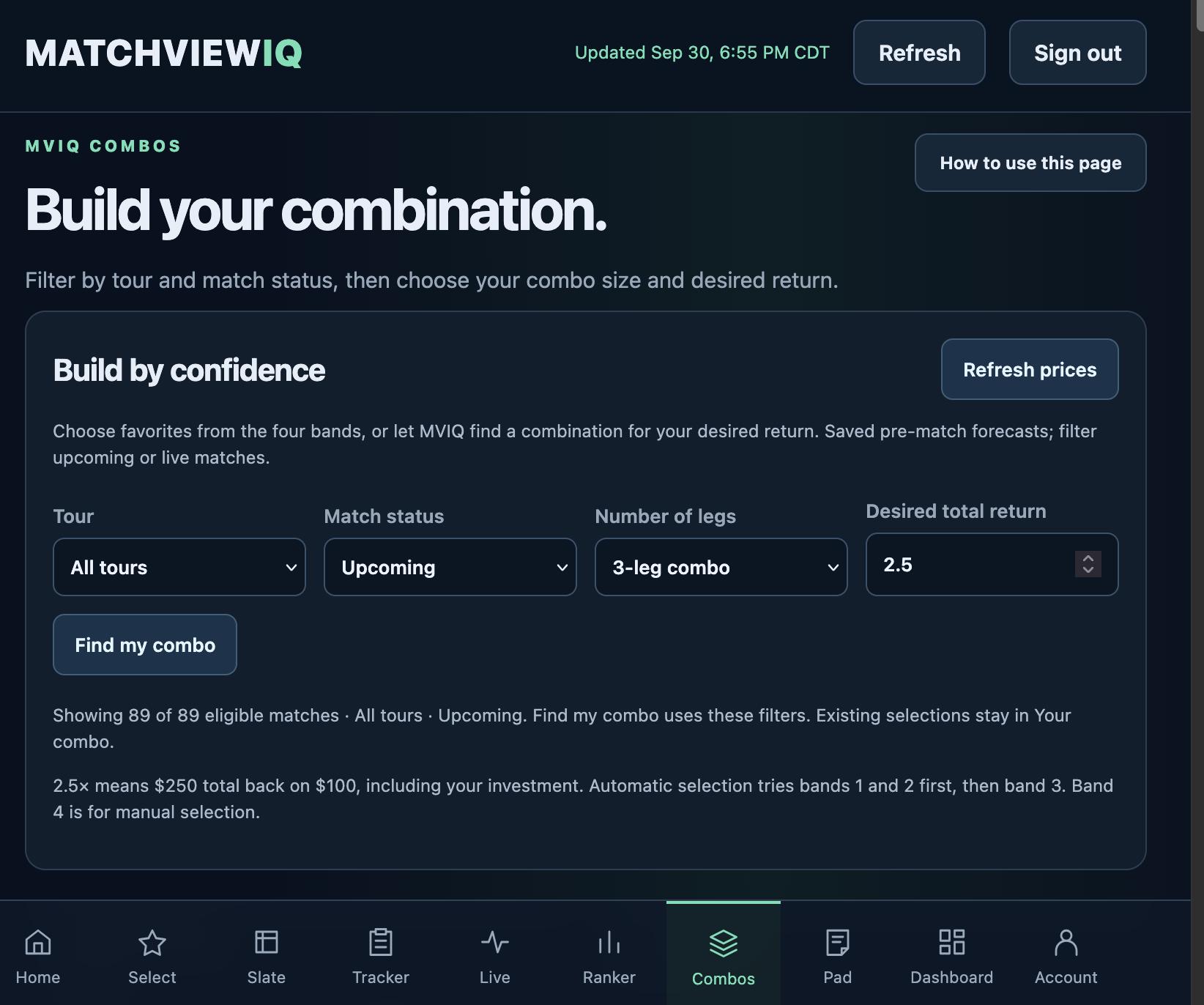
Combos brings eligible matches, saved forecasts, and available prices into a single research view. Choose your own combination or use “Find my combo” to explore one based on your settings.
FIRST, THE SIMPLE VERSION
A leg is one selected match outcome. Two picks make a two-leg combination; three picks make a three-leg combination. When you’re considering an all-must-win combination, every selected outcome has to happen.
Combos helps you research the group. It doesn’t place an order or connect to your trading account.
YOUR COMBINATION, STEP BY STEP
Filter by tour and match status to focus on upcoming or live matches. The forecasts shown are saved pre-match estimates; choosing “Live” doesn’t turn them into live-updating forecasts.
Choose favorites from four confidence bands, or set the number of legs and desired total return, then select “Find my combo.” The beta’s automatic selection tries bands 1 and 2 first, then band 3. Band 4 is for manual selection.
Use “Refresh prices” to request updated quotes, then review the selections and forecasts. Existing selections stay in “Your combo” when you change filters, so check the whole group before making any decisions.
WHY MORE PICKS CHANGES THE PICTURE
Here’s a simple illustration with two hypothetical, independent match outcomes.
estimated chance
estimated chance
estimated chance together
That leaves a 36% chance that at least one doesn’t happen. Add a third independent 80% pick, and the chance of all three is 51.2%. Illustrative math, not a live MVIQ forecast. The calculation assumes independent outcomes and accurate individual estimates; shared factors and forecast errors can change the picture.
READ THE RETURN CORRECTLY
In the app’s example, 2.5× on $100 means $250 total returned, including the original $100. That would be $150 profit before fees if the applicable winning payout is achieved.
A desired return is a search setting—not a promised payout or a measure of how likely the combination is to succeed. Any actual trade depends on the separate platform’s available products, prices, fees, and settlement rules.
KEEP THE CONTEXT
No. A return target describes the result you want to explore, not its likelihood. Review the individual estimates and the chance that every required outcome happens.
No. “Find my combo” helps with selection inside MVIQ. Any trading happens independently on your chosen platform. That platform may not offer the same combination or payout structure.
Yes. Use it to compare match groups, learn how probabilities combine, and organize your tennis research.
EXPLORE THE BETA
Get a closer look at Combos and the rest of MatchViewIQ.
Request early access